
PSA: Everyone can tell that you’re using ChatGPT to write for you.
So, can we stop acting like it’s fine?
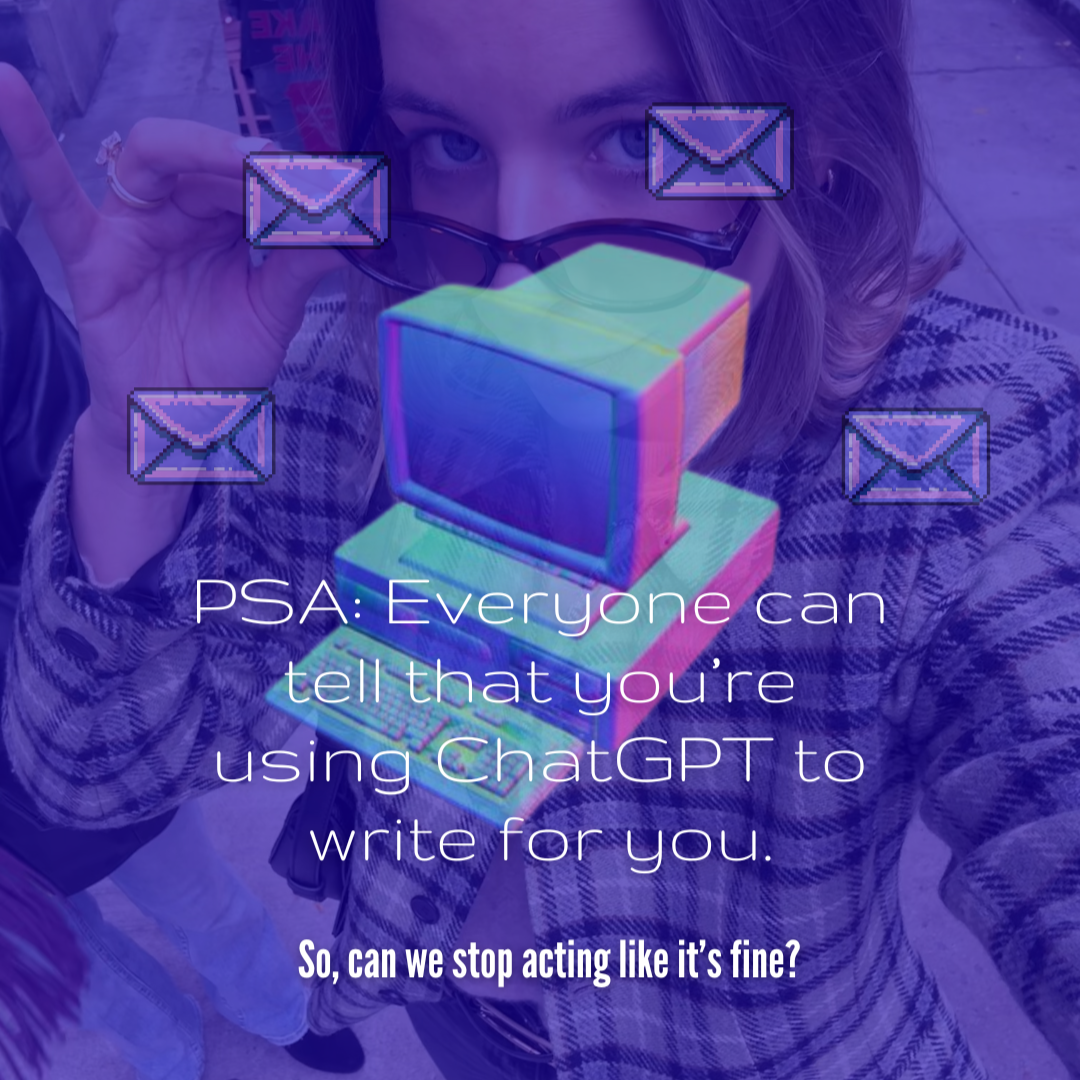
that’s me in the background, judging you for not writing your own emails.
I get it. It’s tempting to use ChatGPT for everything. I fell for it too. It’s easy to type in anything you want and get an answer. But then I started noticing a truly horrifying shift in my day to day life. Instead of taking a few moments to think, I was asking ChatGPT. Instead of coming up with creative ideas in my usual brainstorm process for Instagram posts, I was asking ChatGPT. I started getting fed content about AI on my Tikok, my Instagram. And suddenly, I felt ... generic.
I am someone who has been a creative my entire life. I have been an actor, a writer, a singer, a performer. I value individualism, nuance, and self-expression. And the more time I spend on ChatGPT, the more I recognize the outputs of others who are using it religiously, the more I see those things slowly beginning to disappear in our digital landscape.
That being said, I also value my time, so I do think there are some things that GenAI can be useful for. But we’ll get to that in a future post.
EVERYONE can tell that you’re using ChatGPT to write your blogs. Your captions. Your posts. Your emails. And honestly, I’m getting fed up.
AI stands for artificial intelligence, sure. But remember that it’s NOT intelligent. It’s a predictive text model: all that models like ChatGPT and CoPilot are doing is guessing the next most-likely word or phrase based on your input. That’s it. It is not thinking. It cannot think. It is a machine. And while this has been parroted to you a million times, I always get the same response. “Well, GPT5 can research now!”
Here’s the thing: the research that predictive text models pull from is only as good as the human-created content it can find. More and more, we’re getting what is becoming commonly known as “AI slop” fed back to us. This is when the predictive text model can’t find a relevant, human-created source to pull from, and it starts pulling content that has been created by other predictive text models into its responses. When no one is fact-checking the original output, publishing it as their own material, and then that material is being re-purposed into outputs by the same language model, we end up in a repetitive cycle where the outputs you’re receiving from the AI models you rely on are getting worse and worse every single day.
But look, it’s early 2026. I’m still an optimist this month. Here’s what you can do to get out of your AI reliance, stop sounding generic, and get back to feeling like yourself creatively:
Embrace your unique perspectives Use them! AI cannot replicate the human experience, no matter how hard it tries. Some creators actually think that the next big boom on social media is going to be hyper-niche, nuanced opinions from real experts on specific topics that they can articulately share. Having opinions...the new frontier.
Do creative tasks yourselves. It’s ok to have a little bit of friction in your brainstorming process. Allow yourself time to think through your responses to emails, to write a script for your video using your own words, to brainstorm ideas for your content by putting a good ole pen to paper.
Learn about the predictive text models you are using. If you learned something new from this long-winded caption, you should do more research, because I’ve barely skimmed the surface. Where does your preferred model pull it’s information from? What are the latest updates to the system? Who owns it? What is influencing it?
Remember: AI is not thinking. It’s not intelligent. But you are.
How do you feel about AI going into 2026?